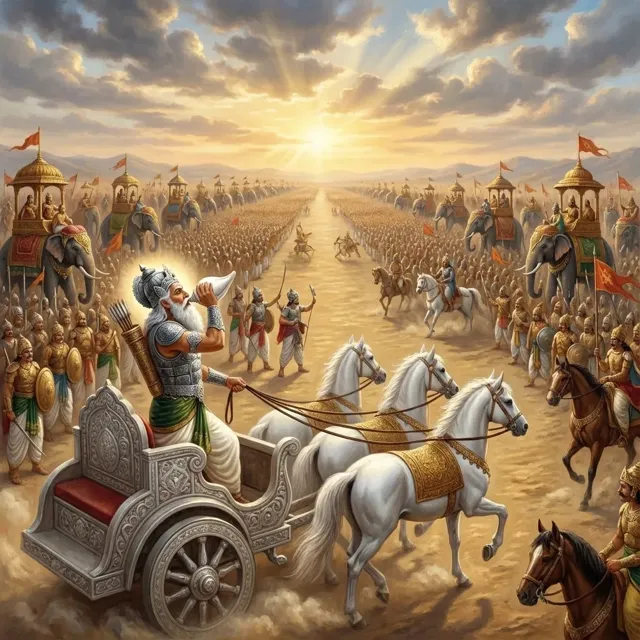
War Declared
Yuddha Rambha
All negotiations fail. Eighteen Akshauhinis converge on Kurukshetra. The greatest military assembly in history stands ready.
With peace efforts exhausted, war becomes inevitable. Armies form alliances, and the vast forces gather at Kurukshetra. The stage is set for the greatest conflict of the age, where Dharma will be tested and established.
Key Takeaways
- The inevitability of conflict when injustice persists
- The polarization of the world into two camps
- Setting the scene for the Bhagavad Gita's delivery
Chapter 17 - War Declared
Common questions and insights about this chapter
Eighteen Akshauhinis—the largest military mobilization in human history—converged on Kurukshetra. Eleven armies pledged to Duryodhana and the Kauravas, while seven stood with the Pandavas for the cause of dharma.
An Akshauhini is a complete army division consisting of 21,870 chariots, 21,870 elephants, 65,610 cavalry, and 109,350 infantry soldiers. The 18 Akshauhinis at Kurukshetra meant millions of warriors on the battlefield.
The Kaurava army was led successively by Bhishma, Drona, Karna, and Ashwatthama. The Pandava army was commanded by Dhrishtadyumna, with key warriors including Arjuna, Bhima, Abhimanyu, and the sons of Draupadi.
Kurukshetra is called Dharmakshetra (field of dharma) because it was an ancient sacred land where King Kuru had performed intense austerities. It represents not just a physical battlefield but the cosmic stage where righteousness would triumph over adharma.
Chapter 17 Quiz
Progress through levels to deepen your wisdom