# The Gita in 15 Minutes
**Narrator:**
The Bhagavad Gita — literally "The Song of the Lord" — is a 700-verse philosophical dialogue, eighteen chapters long, that sits embedded inside a much larger Sanskrit epic called the Mahabharata. The Gita itself takes maybe an hour and a half to read in any decent translation. The first time you read it, you will probably think it's a manual for how to fight a war. The second time, you'll realize it's a manual for how to stop being afraid of dying. The third time, you'll notice that almost nothing it says is actually about war at all.
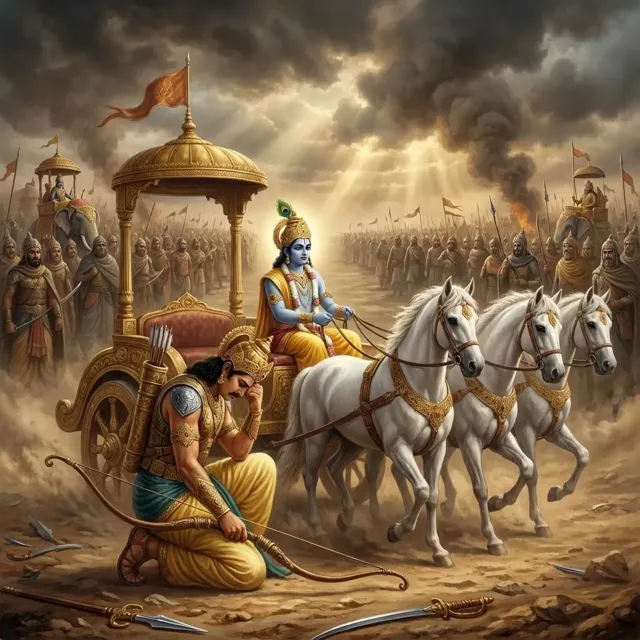
The frame is this: two armies are about to fight a war. They are drawn up across a field. The conch shells have been blown. Just before the first arrow is loosed, the warrior at the center of one army — Arjuna — asks his charioteer to drive him out into the no-man's-land between the armies so he can look at who he is about to kill.
His charioteer is Krishna. Krishna is also, by the time we meet him in this chapter, several thousand years of religious literature into being recognized as God — a particular avatar of Vishnu, the preserver. But on this morning he is a chariot driver, and Arjuna is his student, and what is about to be said over the next ninety minutes is — by any honest reading of human literature — one of the deepest things any text has ever said about how to live.
## What Arjuna Saw
**Narrator:**
He looked at the army across the field. He saw his cousins. He saw his old teacher Drona, who had taught him the bow. He saw Bhishma, the patriarch who had raised him. He saw uncles and brothers-in-law and friends from forty years of his life.
His knees went out from under him. He dropped his bow. He told Krishna:
**Arjuna:**
"I will not fight. Whatever the cause, however righteous, I will not strike at these men. Better to be killed by them than to kill them. Better to live in the forest as a beggar than to win this kingdom by walking over their bodies. I will not."
**Narrator:**
This is the entirety of Chapter 1. A man at the edge of his life realizing — exactly when he must act — that he cannot. The Mahabharata, the epic that contains the Gita, is largely about *what* this war was for and *why* it had to happen and *who* was right and *who* was wrong. The Gita is what Krishna says to the man who, looking at the cost of the answer, refuses to fight.
## Krishna's Reply
**Narrator:**
What Krishna says in response — and what unfolds across the next seventeen chapters — is not, primarily, an argument that Arjuna should fight. Krishna is not trying to *convince* him. Krishna is trying to *teach* him the only thing that will allow him, or anyone else, to act in a world where every meaningful action has terrible consequences. Krishna's teaching, compressed, is this:
You are not what you think you are. You are not the body that will live or die in this battle. You are not the role of warrior that has trapped you here. You are not even the choice between fighting and not fighting. You are the *consciousness that watches* all of this — and that consciousness was never born, has never changed, will never end.
What dies in the body is not you. What suffers in defeat is not you. What enjoys victory is not you. *You* are something else, and once you see what that something is, the question of whether to fight is no longer a question of self-preservation. It is a question of duty (*dharma*), aligned correctly, performed without attachment to its outcome.
This is the Gita's central teaching. Everything else in the text radiates from it.
## The Three Yogas
**Narrator:**
Krishna lays out, across the middle chapters, three paths to the realization above. They are not in competition. They are three doors into the same room.
**Karma Yoga** — the path of action. Act in the world, but act without grasping at the fruits of your action. The most-quoted verse of the entire Gita comes from this teaching:
**Krishna:**
"Karmaṇy-evādhikāras te mā phaleṣu kadācana —
You have a right to action only. Never to the fruits of action.
Let the fruit of action not be your motive,
And do not become attached to inaction."
**Narrator:**
This is not "don't care about outcomes." It is "don't be owned by outcomes." Plant the seed; water it; do not stand over the seedling demanding it grow. The outcome of an action is not yours; it belongs to the world, to causation, to the field. What is yours is the *doing*. Do it well. Then let it go.
**Bhakti Yoga** — the path of devotion. Love something larger than yourself — and let that love be the orientation of every action. For Krishna, this means love of the divine; in modern practice, it has meant love of a teacher, of a community, of a cause, of an art. The point is not the object. The point is that the self, oriented by love, becomes thinner, and the strain of being the center of one's own universe falls away.
**Jnana Yoga** — the path of knowledge. The slowest of the three. Sit with the texts. Sit with the question *who am I, really.* Watch the answers fall away — *not the body, not the breath, not the mind that breathes, not the thinker that thinks the thoughts.* Eventually what remains is the witness. The witness is you.
Krishna does not order Arjuna to pick one of these. He explains all three. Arjuna, by temperament, is a man of action — so Krishna leans on *karma yoga* as the path closest at hand. But the Gita is honest that any of the three, walked with sincerity, arrives at the same place.
## The Cosmic Form
**Narrator:**
Around the middle of the dialogue, something extraordinary happens. Krishna has been teaching Arjuna using human language, using analogy, using metaphor. Arjuna, exhausted, asks for a direct demonstration: *Show me. Show me what you really are.*
Krishna gives him "the divine eye" — a temporary perception above his ordinary senses — and reveals what is called the *Vishvarupa*, the cosmic form. Chapter 11 of the Gita. Arjuna sees, in a single instant, all of creation contained in Krishna's body. Suns and moons and continents. All the gods. All the demons. All the dead, all the living, all who have not yet been born. The faces of the warriors on the battlefield being drawn into Krishna's many mouths and consumed.
**Krishna:**
"Kālo'smi loka-kṣaya-kṛt pravṛddho —
I am Time, the great destroyer of worlds,
And I have come to consume all beings.
Even without you, all these warriors arrayed for battle shall cease to be."
**Narrator:**
This is the verse J. Robert Oppenheimer is said to have remembered when he watched the first atomic bomb test in New Mexico in 1945. He said it to himself in Sanskrit; he had memorized the chapter as a young man. He understood, in that moment, that he had not invented anything new. He had only briefly held an instrument of a force older than human history.
Arjuna, in the Gita, asks Krishna to stop. He cannot bear the sight. He asks for the familiar four-armed form back, the chariot driver, the friend. Krishna grants it. The vision ends. But what was seen, was seen. And from this moment forward in the dialogue, Arjuna no longer asks *whether* to act. He asks only *how*.
## The Three Modes
**Narrator:**
The later chapters of the Gita develop a psychology — a theory of why human beings act the way they do. Krishna names three *gunas* — qualities — that braid through every personality, every action, every food, every relationship.
*Sattva* is clarity, balance, calm, steadiness. *Rajas* is passion, drive, restlessness, ambition. *Tamas* is heaviness, dullness, fear, inertia. Nobody is purely one. Most people, most lives, are a tangled rope of all three. The work of spiritual practice, Krishna says, is not to eliminate *rajas* or *tamas* but to recognize them, to refine the proportions, to act increasingly from *sattva* — and eventually, when one stops being identified with any of them, to be free.
## The Closing Verses
**Narrator:**
The Gita ends — Chapter 18, the longest chapter — with Krishna restating the entire teaching in shorter form, and then with a final verse that has been recited at deathbeds for two thousand years:
**Krishna:**
"Sarva-dharmān parityajya
Mām ekaṁ śaraṇaṁ vraja —
Abandon all duties, all paths, all systems.
Take refuge in Me alone.
I will free you from all evil. Do not grieve."
**Narrator:**
The line is shocking, after seventeen chapters of careful teaching about duty. *Abandon all dharmas.* But the line is exactly the resolution of everything that came before. Once the self has dissolved — once one acts from love, or from witnessing, or from skillful detachment — *dharma* takes care of itself. You do not need to think about it anymore. You only need to take refuge in what is already, always, holding the whole field.
Arjuna picks up his bow. He says:
**Arjuna:**
"Naṣṭo mohaḥ smṛtir labdhā tvat-prasādān mayācyuta —
My delusion is destroyed. By Your grace I have regained my memory of who I am. I stand firm now. My doubts are gone. I will act according to Your word."
**Narrator:**
The Gita ends with Arjuna picking up his bow.
## What Survived
**Narrator:**
The text has been the most-translated Indian work in history. Gandhi carried a pocket Gita his entire life and called it his mother. Aldous Huxley wrote a preface for one translation. Emerson and Thoreau read it. Yeats read it. The poet Robert Oppenheimer recited it. A modern American philosopher named Jacob Needleman called it "the supreme yoga of self-knowledge."
What is true about it is what every reader eventually finds: it does not actually ask you to fight a war. It asks you to take an honest look at *the war you are already in* — which is your own life — and to act in it without being undone by it. Whatever your battlefield. Whatever your bow.
The dialogue takes place in the few minutes between two armies drawing up and the first arrow being loosed. The implication is that *that* is the situation every conscious human being is permanently in. The arrow is always about to be loosed. The cousins are always across the field. And Krishna, the teaching says, is always present — in some form — for anyone willing to hear what is being taught.
## How To Read It
**Narrator:**
If this is your first encounter, read a translation that is honest about its limitations. Eknath Easwaran's translation is gentle and modern. Stephen Mitchell's is poetic but loose. Barbara Stoler Miller's is the cleanest academic version. Swami Sivananda's is the standard within the tradition.
Or — if you would like — start with the eighteen chapters of EpicGita on this site. They are presented at the pace of a serial novel, one Krishna-Arjuna exchange at a time, with the historical context of the Mahabharata that contains them. You can read them in any order. But the slow read — Chapter 1 to Chapter 18 — is the one the text was written for.
Whatever you do, do not skim it. Nothing in the Gita is for skimming. Krishna is, in the words of the eighteen-century commentator Shankara, *unhurried* — and the text was composed by people who shared that quality. Take your time. The chariot is not moving.
ॐ
The Sacred Chapters
भगवद्गीतासङ्क्षेपः
Krishna's full teaching to Arjuna compressed — Arjuna's collapse, the three yogas (karma, bhakti, jnana), the cosmic form in Chapter 11, the three gunas, and the closing instruction to abandon all dharmas and take refuge in love.
Begin ReadingScroll down to read chapter
ॐ
Unfolding the sacred verses...
Quiz not available for this chapter yet.