# The Prequel in 12 Minutes
**Narrator:**
The Bhagavad Gita opens on the morning of a battle. Two armies face each other across a field. The warrior Arjuna asks his charioteer, Krishna, to drive him to the center, where he can look at the men he is about to kill. He sees his cousins. He sees the teacher who trained him. He sees the grandfather who raised him. His knees give out. He drops his bow.
The Gita is what happens next.
But to understand why those two armies are there — why Arjuna cannot simply walk away, why Krishna is his charioteer at all, why the war must happen and why it must happen *today* — you have to know the seventy years of family history that brought them to this morning. That family history is the prequel.
This is the prequel in twelve minutes.
## Shantanu and the River
**Narrator:**
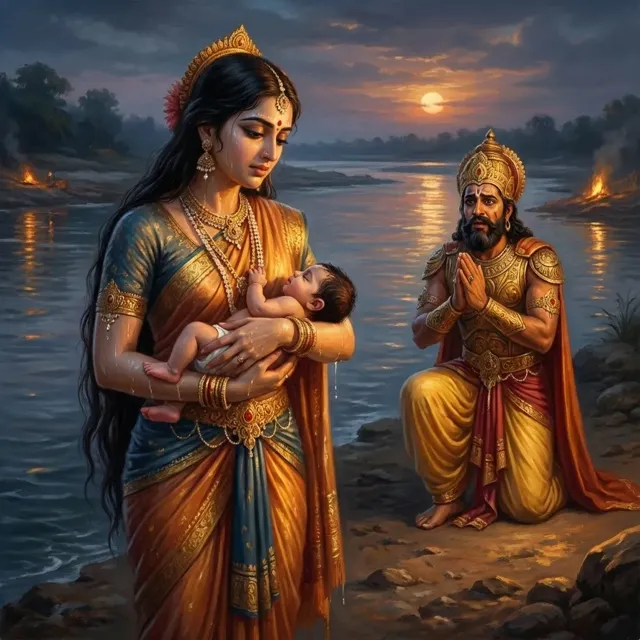
The story begins three generations before the war. King Shantanu of Hastinapura, a powerful and lonely king, walks along the bank of the river Ganga and meets a woman so beautiful that he loses his power of speech. He asks her to marry him. She agrees, on one condition: that he never ask her where she goes or what she does. He swears.
She bears him seven sons. She drowns each one in the river immediately after birth. Shantanu, bound by his oath, watches and says nothing. When the eighth son is born and she carries him to the water, Shantanu breaks. He demands she stop. She does. She returns the child to him and reveals herself: she is the river-goddess Ganga, the seven drowned sons were celestials born to a brief curse, and she has been releasing them back to the heavens. The eighth child is the only one to be raised on earth. His name is Devavrata.
Ganga vanishes back into the river. Shantanu raises the boy alone.
## Bhishma's Vow
**Narrator:**
Devavrata grows up to be the greatest warrior, scholar, and statesman of his age. Years later, Shantanu meets another woman — Satyavati, a fisherman's daughter — and asks her father for her hand. Her father refuses, citing that any son of theirs would have a weaker claim than Devavrata. Shantanu, grieving, walks away.
Devavrata learns of his father's grief. He rides to Satyavati's father and makes an oath that becomes one of the most famous in any literature: *not only will I yield my claim to the throne, I will never marry. I will never have children. My line ends with me. No descendant of mine will ever contest your daughter's children for the crown.*
The gods, watching from above, drop flowers from the sky. The oath is so terrible that Devavrata is renamed from that day forward: **Bhishma**, "He of the Awful Vow."
Satyavati marries Shantanu. Bhishma keeps his oath for the next eighty years.
## The Two Branches
**Narrator:**
Several generations pass. Satyavati's grandsons are two: Dhritarashtra, the elder, born blind; and Pandu, the younger. By the law of the kingdom, Dhritarashtra cannot rule (because of his blindness), so the throne passes to Pandu.
Dhritarashtra marries Gandhari, who out of devotion ties a cloth over her own eyes to share her husband's blindness. They have **one hundred sons** — born in a complicated mythical sequence — and one daughter. The eldest of the hundred is **Duryodhana**. These hundred are called the *Kauravas*.
Pandu marries Kunti and Madri. He is unable to father children directly because of an old curse. But Kunti has a mantra — given to her in childhood — by which she can summon any god to father a son. Through this mantra, the gods themselves father her three sons: **Yudhishthira** by Dharma, the god of duty. **Bhima** by Vayu, the god of wind. **Arjuna** by Indra, the king of gods. Madri uses the same mantra to bear two more: **Nakula** and **Sahadeva**, by the twin Ashvins. These five are called the *Pandavas*.
Pandu dies. Madri commits sati on his pyre. Kunti and the five Pandavas come home to Hastinapura to live with their cousins, the one hundred Kauravas.
## The Schoolyard
**Narrator:**
The cousins grow up together. They train together, under the great teacher Drona. They eat together. They sleep in the same palace.
And from the beginning, Duryodhana hates them.
Bhima is stronger than all hundred of Duryodhana's brothers combined. Arjuna is a better archer than anyone alive. Yudhishthira is wiser than the king. The Pandavas, by every measure, outshine the Kauravas. Duryodhana, watching this, decides that as long as the Pandavas live, he will never inherit. The Kauravas attempt to assassinate Bhima, more than once. They fail. The cousins continue to train together. The hatred sets.
By young adulthood, Yudhishthira has been declared the crown prince. He will inherit Hastinapura. Duryodhana cannot bear it.
## The Lacquer House
**Narrator:**
Duryodhana convinces his father — the blind king Dhritarashtra — to send the Pandavas on a pilgrimage to a town called Varanavata. While they travel, Duryodhana sends agents ahead to build them a palace made of *lac* — a wax-like resin so flammable a single torch can engulf the entire building.
The Pandavas arrive. They are warned in time. They dig a tunnel out of the palace and escape just before Duryodhana's men set the building on fire. The bodies of a beggar woman and her five sons, who took shelter there that night, are found in the ashes. Duryodhana believes the Pandavas are dead. The Pandavas, knowing this, decide to remain dead — to live in disguise, in the forests, for a year.
It is during this year that Arjuna wins his wife. King Drupada of Panchala holds a *svayamvara* — a great archery contest — for his daughter Draupadi. The challenge is to string an impossible bow and shoot an arrow through a revolving wheel into the eye of a fish hanging above. Arjuna, disguised as a brahmin, walks in, strings the bow, and shoots.
He brings Draupadi home to the hut where his brothers are staying. He calls out: *Mother, look what we have won.* Kunti, without turning around, says: *Whatever it is, share it equally among the five of you.* A mother's instruction, once given, cannot be unsaid. So Draupadi becomes the wife of all five Pandavas.
The Pandavas reveal themselves to be alive. The kingdom is split. Hastinapura goes to Duryodhana; a wilderness called Khandava is given to the Pandavas. The Pandavas, with Krishna's help, transform it into a magnificent city called **Indraprastha**.
## The Dice Game
**Narrator:**
Indraprastha prospers. Yudhishthira is crowned. The five Pandavas hold a great sacrifice (*Rajasuya*) that declares Yudhishthira emperor over all neighboring kings. Duryodhana attends. He sees the magnificent city, the silver and gold, the wealth. His hate sharpens to a knife-edge.
He goes to his uncle Shakuni — a brilliant gambler with a magic set of dice — and conspires. Duryodhana invites Yudhishthira to a "friendly" game of dice in Hastinapura. Yudhishthira, by the warrior code, cannot refuse a royal invitation. He travels with his brothers and Draupadi.
The game is rigged from the first throw. Shakuni's dice never lose. Yudhishthira stakes his gold. He loses. His chariots. Lost. His city. Lost. His brothers. Lost. Himself. Lost. Finally, in the dead silence of the hall, Shakuni whispers: *Stake Draupadi.* Yudhishthira does. He loses her too.
Duryodhana drags Draupadi by her hair into the assembly. He orders his brother Dushasana to disrobe her in front of the entire court. Krishna, from far away, hears her cry and protects her — when Dushasana pulls at her sari, the cloth becomes endless. He pulls, and pulls, and falls exhausted. She remains clothed. But the moment is permanent. She swears, in the hall, that her hair will not be braided again until it has been bathed in Dushasana's blood.
Dhritarashtra, panicking, returns the kingdom and frees the Pandavas. But Duryodhana convinces him to allow one more roll. This one, if lost, sends the Pandavas into thirteen years of exile — twelve in the forest, the thirteenth incognito. If they are recognized during the thirteenth year, the cycle starts over. Yudhishthira loses again.
The five brothers and Draupadi walk out of Hastinapura, into the forest. They will not be seen as themselves for thirteen years.
## The Years of Exile
**Narrator:**
Twelve years in the forest. They live as ascetics. Arjuna travels to the Himalayas and acquires divine weapons from Indra and Shiva. They visit hermits, hear teachings, gather strength. Many books of the Mahabharata cover this period — the tale of Nala and Damayanti, the killing of Jatasura, the encounter with the Yaksha at the lake.
The thirteenth year — they spend in disguise, working in the court of King Virata. Yudhishthira as a chess teacher. Bhima as a cook. Arjuna, cursed by an apsara into being a eunuch for one year, as a dance instructor for the princess. Nakula as a horse trainer. Sahadeva as a cowherd. Draupadi as a hairdresser to the queen.
They survive the year. At its end, they reveal themselves. The exile is complete. By the original agreement, half the kingdom now reverts to them.
Duryodhana refuses.
## The Last Embassy
**Narrator:**
Krishna — who has been the Pandavas' counselor throughout — goes to Hastinapura himself as ambassador. He asks Duryodhana for only what is fair: half the kingdom; if not half, then five villages; if not five, then five plots of land; if not even that, then *any peace at all*. Duryodhana refuses every offer. He says, in the words that have echoed for two thousand years:
**Duryodhana:**
"I will not give the Pandavas land the size of the point of a needle. Not without war."
**Narrator:**
Krishna leaves. Both sides muster their armies. Bhishma, the great patriarch, has lived through all of this. By his eighty-year-old oath, he is loyal to whoever sits on the throne of Hastinapura. That is Duryodhana. So Bhishma, who loves the Pandavas, who taught them, will lead the army that fights against them.
Drona, their teacher, the same. By feudal duty he serves the king.
The cousins muster on opposite sides. Krishna offers himself to either side — to one he will be a non-combatant charioteer, to the other he will lend his enormous army. Duryodhana asks for the army. Arjuna asks for Krishna. So Krishna becomes Arjuna's charioteer. The Pandavas have Krishna. The Kauravas have Krishna's army.
The armies face each other at a place called Kurukshetra. The conch shells are blown.
## The Last Moment
**Narrator:**
On the morning of the first day, Arjuna asks Krishna to drive his chariot out into the center, between the two armies, so he can see who he is about to kill.
He sees Bhishma, who raised him.
He sees Drona, who taught him the bow.
He sees his hundred cousins, who he played dice with as a child.
His knees go out from under him. He drops his bow.
That is where the Bhagavad Gita begins. That is the morning at which the prequel ends.
The eighteen chapters of the Gita, all 700 verses, all happen between this moment and the first arrow being released.
Read those eighteen chapters next.
ॐ
The Mahabharata Before the Gita
महाभारतपूर्वकथा
Seventy years of family history that brought Arjuna to the battlefield — Shantanu's marriage to Ganga, Bhishma's awful vow, the hundred Kauravas, the Pandavas' divine births, the lacquer house, the dice game, the thirteen-year exile, and Krishna's failed last embassy.
Begin ReadingScroll down to read chapter
ॐ
Unfolding the sacred verses...
Quiz not available for this chapter yet.