# The Sequel in 12 Minutes
**Narrator:**
The Bhagavad Gita ends with Arjuna picking up his bow. The 700 verses of Krishna's teaching have concluded. Arjuna says he will fight. He has remembered who he is.
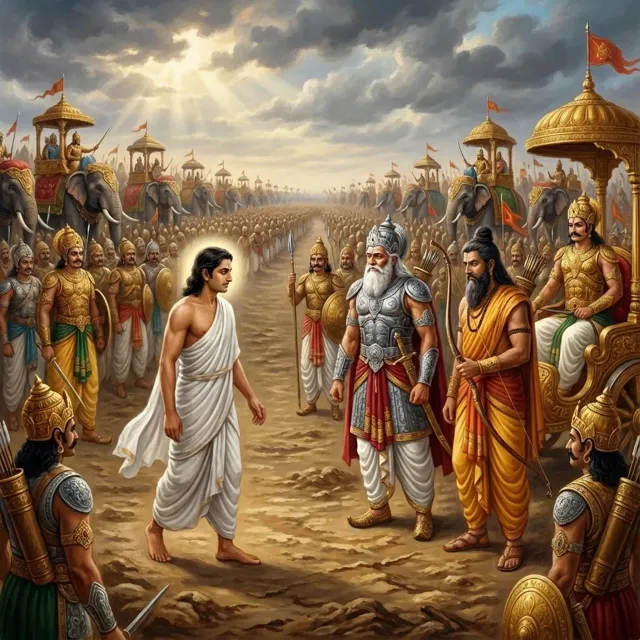
What happens next is the war the Mahabharata has been building toward for a hundred thousand verses. Eighteen days at Kurukshetra. Five hundred million soldiers — by the epic's own count, almost certainly an exaggeration, but the point is *all the warriors of the known world.* When it ends, only a handful are alive.
This is what comes after the Gita.
## The First Day
**Narrator:**
The first arrow is loosed by Bhishma. The grandfather. The man who raised Arjuna. He leads the Kaurava army, by his eighty-year-old oath of loyalty to whoever sits on the throne — and that is Duryodhana. The Pandavas, his beloved adopted grandsons, face him across the field.
The day's fighting is fierce but inconclusive. The two armies — combined two and a half million strong — return to camp. At sunset they declare a truce. They visit each other's tents as old friends. They share wine and ask after each other's families. Then sleep. Then dawn. Then more arrows.
This is the rule of Kurukshetra: gentlemanly by night, lethal by day. It is the last time in Indian military history that war will look anything like this.
## Bhishma Falls
**Narrator:**
For ten days Bhishma fights at the head of the Kaurava army. He is unkillable in the ordinary sense. The Pandavas, watching the daily toll of their own troops, ask Krishna how to end this.
Krishna says: *Bhishma is bound by his vows. One of those vows is that he will not raise his weapon against a woman. Find a woman who was once a man.*
So on the tenth day, Arjuna places his chariot behind Shikhandi — a warrior born female, reincarnated from a princess named Amba who, in a previous life, had been wronged by Bhishma and had sworn revenge. Bhishma will not fire at Shikhandi. Arjuna, sheltered behind, looses arrow after arrow. Bhishma falls.
But he does not die. He has the boon of choosing his own moment of death. He lies on a bed of arrows — the bristling points of dozens of shafts holding his body off the earth — and asks for water. Arjuna fires an arrow into the ground beside him; a clear spring rises and reaches his lips.
Bhishma will lie on that bed of arrows for fifty-eight days. He will not die until after the war is over. He will use that time to teach Yudhishthira how to be king. The conversations are recorded in the *Shanti Parva* and *Anushasana Parva* — together longer than the entire Iliad. But not for today.
## Drona Falls
**Narrator:**
Drona, the teacher of both sides, takes command. He is invincible while he holds his weapons. The Pandavas, advised by Krishna, devise a trick.
Bhima kills an elephant named Ashwatthama. Then he shouts, across the battlefield: *Ashwatthama is dead.* Drona's son is also named Ashwatthama. Drona, hearing this, hopes — but cannot believe — that his son has fallen. He asks Yudhishthira, the most honest man on earth, to confirm.
Yudhishthira hesitates. Then he says: *Ashwatthama is dead.* He mutters under his breath: *the elephant.* But the chariots of war drown out the qualifier. Yudhishthira's chariot, which has hovered four inches off the ground his entire life because of his honesty, settles to the earth for the first time. He has just told a half-lie.
Drona lays down his weapons. He sits cross-legged on the floor of his chariot. He closes his eyes and goes into meditation, ready to die. Dhrishtadyumna, the Pandavas' commander, walks up and cuts off his head.
## Karna and Arjuna
**Narrator:**
Karna takes command of the Kaurava army. He is Kunti's secret first son — born of the sun god, abandoned in a basket on a river, raised by a chariot-driver, eventually adopted by Duryodhana, sworn to him for life. He is, by everything Kunti and Krishna have privately learned, Arjuna's older brother. None of the warriors know.
He and Arjuna meet on the seventeenth day. The duel is one of the great battles of any literature. Karna's chariot wheel sinks into the mud. He dismounts to free it. Arjuna, by warrior code, should not fire on an unarmed opponent. Krishna whispers: *Shoot.* Arjuna remembers Karna mocking Draupadi at the dice game. He remembers his brothers' faces. He looses the arrow. Karna falls dead in the mud, his own wheel still half-buried beside him.
It is only at this point that Kunti, watching from the women's camp, tells her sons who Karna really was. They have killed their oldest brother. They did not know.
## The Last Days
**Narrator:**
Shalya, Bhishma's brother, takes the field. He falls. Duryodhana's army is now small enough to count by chariots.
Bhima, who has been waiting his entire life for this, hunts Duryodhana into a lake. The two duel with maces. By warrior code, you do not strike below the waist. Bhima, on Krishna's silent signal, breaks the code. He smashes Duryodhana's thighs with his mace. Duryodhana falls. He bleeds out, slowly, on the bank of the lake.
That night, Ashwatthama — Drona's real son, who has survived — sneaks into the Pandavas' camp while they sleep. He cuts the throats of the five sons of Draupadi (the children the Pandavas had between them and Draupadi). He cuts the throat of Dhrishtadyumna, the man who killed his father. He cuts the throats of every Pandava soldier he can find. By dawn the camp is a slaughterhouse.
The five Pandava brothers, who had been camped separately that night, awake to discover the bodies of their children.
The war ends here. The Kauravas are dead. The Pandavas have won. Five soldiers and one woman remain from an army of millions.
Draupadi, by torchlight, washes her hair in Dushasana's blood and rebraids it. The oath she made at the dice game, fourteen years earlier, is fulfilled.
## After the Battle
**Narrator:**
The Mahabharata does not end with the war. It has eighteen more sections, *parvas*, after Kurukshetra. They are sometimes harder to read than the war itself.
The Pandavas are now the only royal family in the world. Yudhishthira is crowned. But the kingdom is empty. There are no warriors. There are no princes. There are widows in every village. Yudhishthira, who has dreamed of being king his whole life, sits on the throne and is sick with what he has done.
Bhishma, still on his bed of arrows, instructs him. He recites enormous treatises on dharma, on governance, on the laws of inheritance, on the duties of a king. Yudhishthira receives them. After fifty-eight days, when the sun finally turns north and the celestial calendar allows, Bhishma releases his hold on life and dies. His body is cremated by the river. His soul ascends.
The Pandavas rule for thirty-six years. The kingdom is prosperous. But the Yadavas — Krishna's own people — are cursed. They drink themselves into a brawl on a beach. They kill each other with reeds plucked from the shore, which have become enchanted iron rods. The entire clan dies in a single afternoon. Krishna himself walks into a forest and is shot dead by a hunter who mistakes his bare foot for a deer.
When the Pandavas hear of Krishna's death, Yudhishthira understands that the *yuga* has ended. The age of Krishna is over.
## The Final Walk
**Narrator:**
The five brothers and Draupadi crown their grandson Parikshit (Abhimanyu's son, miraculously revived in the womb during the war) as the next king. They put on the robes of mendicants. They walk north. They climb toward the Himalayas, toward Mount Meru, the world's axis.
A dog joins them on the walk.
One by one, they fall. Draupadi first — because, the text says, she favored Arjuna over the other four. Then Sahadeva — because of pride in his learning. Then Nakula — for vanity in his beauty. Then Arjuna — for the sin of boastfulness about his skill. Then Bhima — for greed.
Only Yudhishthira keeps walking. The dog is still with him.
At the foot of the heavenly stairs, the god Indra meets him with a chariot. *Come up,* Indra says. *But leave the dog.*
Yudhishthira refuses. *I will not abandon a companion who has been loyal to me. If the dog cannot come, I will not come.*
The dog reveals himself to be Dharma — the god of duty, Yudhishthira's celestial father — who has been testing him this entire walk. They ascend together.
In heaven, Yudhishthira finds Duryodhana enthroned in honor. He sees no sign of his brothers. He demands to know what is happening.
He is shown his brothers in what looks like hell. He says: *Then I will stay here with them.* He sits down beside them in the darkness.
It dissolves. It was the final test. The "heaven" with Duryodhana was illusion. The "hell" was illusion. Once Yudhishthira chose to stay with those he loved over heaven without them, his real heaven appears — and his brothers, and Draupadi, and Krishna are all there.
The Mahabharata ends.
## What This Is For
**Narrator:**
The sequel to the Gita is not, primarily, the story of how the Pandavas won. It is the story of what winning a war costs. By the end of the Mahabharata, almost no one is left. The five brothers who survived are old, broken men. The kingdom they won is a memorial to the kingdom that existed before. The teacher Krishna, who held everything together, dies of a stray hunter's arrow.
The Bhagavad Gita, in eighteen chapters, taught Arjuna how to act in a world where every action costs something. The sequel shows you what those costs look like — and shows the same Arjuna, fifty years later, dropping to the ground halfway up a mountain, dying of his own pride. The lesson did not stick all the way. It rarely does.
The dog who walks with Yudhishthira at the end is, by some readings, the most important figure in the whole epic. He is loyalty without justification — the only thing in the story that survives every betrayal and every sacrifice and every twist of fate. He is the only character in the final scenes whose nature is exactly what it appears to be.
That is the Mahabharata, after the Gita. That is the sequel.
Read the Gita slowly. Then, if you are ready, the rest.
ॐ
The Kurukshetra War and Its Aftermath
महाभारतोत्तरकथा
What happens after the Gita — the eighteen-day war at Kurukshetra, Bhishma on his bed of arrows, Karna and Arjuna, the night of the throat-cuts, Krishna's death, and Yudhishthira's final walk up the Himalayas with a dog beside him.
Begin ReadingScroll down to read chapter
ॐ
Unfolding the sacred verses...
Quiz not available for this chapter yet.