# The Minister, the Signet Ring, and the War of Wits
This is the story of a political thriller written nearly seventeen hundred years ago by Vishakhadatta — a play that contains no romance, almost no battle, and not a single scene of a sword drawn in anger. Its weapons are intelligence, loyalty, a forged letter, and a ring. Its central drama is not the defeat of a great man but the winning of him over. And it ends not with a funeral but with a bow.
## The World the Play Inherits
By the time the curtain rises, the major bloodshed is already done.
The Nanda dynasty — corrupt, arrogant, the dominant power of northern India for generations — has been overthrown. A young man of obscure origin named Chandragupta Maurya now sits on the throne of Pataliputra, the richest city in the subcontinent.
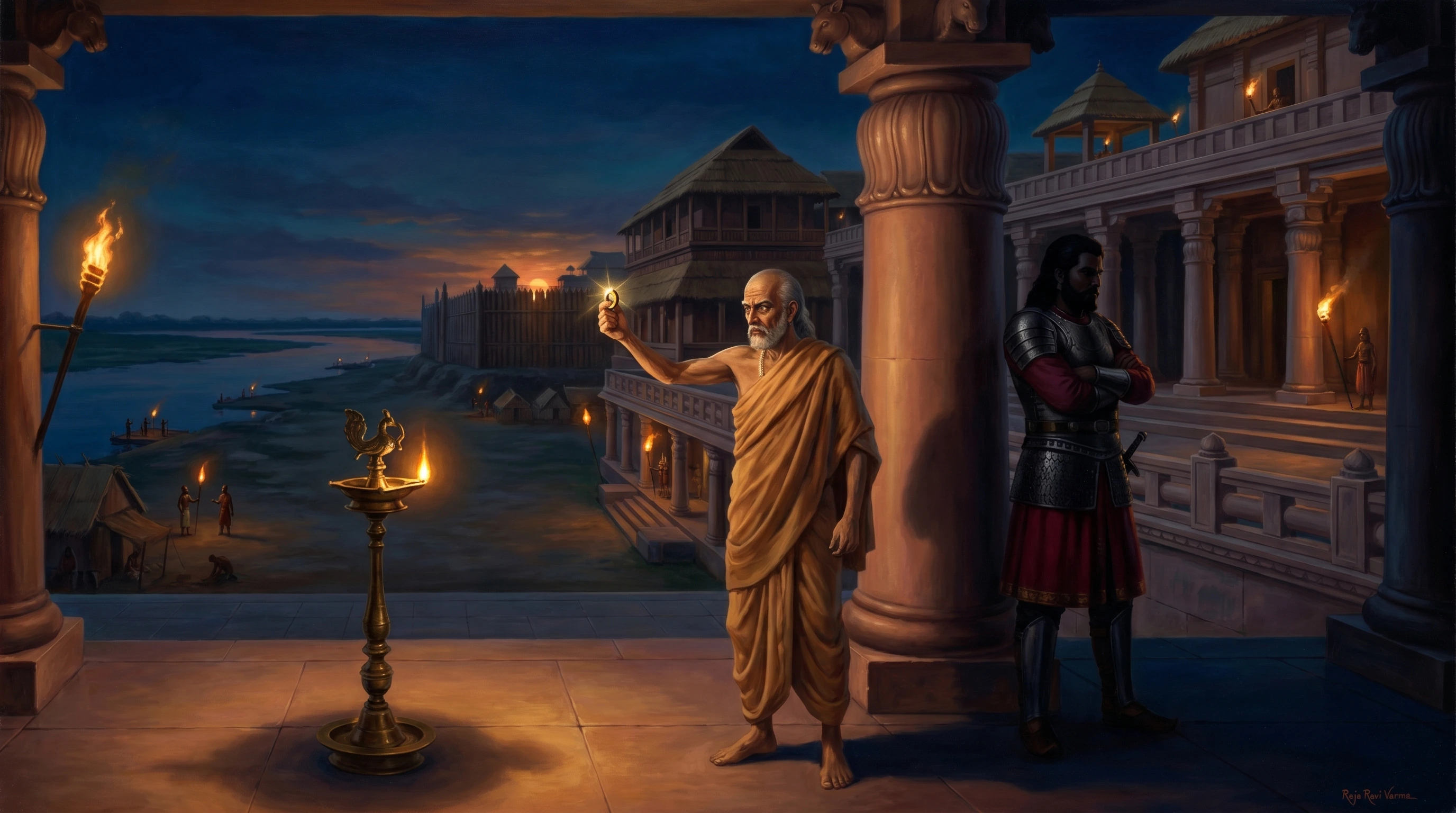
Behind him stands the man who made it all possible: Kautilya, the brahmin strategist — known also as Chanakya and Vishnugupta. History would eventually remember him as the author of the Arthashastra, the most pitiless manual of statecraft ever written. He is small, dark, crooked of limb and crookeder of method. He has an unbound lock of hair on his head that he swore would remain unbound until the Nandas were destroyed. He has now tied it up. He has won.
Except that he has not.
The Nandas had a minister. His name was Rakshasa — which, ironically, means demon. He was the ablest administrator and strategist in the empire, utterly loyal to his dead masters and utterly incorruptible. While the coup was proceeding, Rakshasa escaped.
And a Rakshasa at large — in possession of his knowledge, his contacts, his network of loyal officers across the provinces — is more dangerous than the Nanda army Chanakya just defeated. One overthrown dynasty can be replaced. But consider the other man: he carries the entire administrative intelligence of that dynasty in his head, he commands personal loyalty across the frontier kingdoms, and he will work without rest or payment to restore what he has lost. That man, if he remains an enemy, guarantees that the Maurya throne is never secure.
So Chanakya faces the real problem. Not the throne. Rakshasa.
## The Alliance Against Chandragupta
Rakshasa has moved fast. He has found his instrument: Malayaketu, the young prince of a mountain kingdom whose father Parvataka died under suspicious circumstances during the campaign that brought Chandragupta to power. Malayaketu burns with grief and ambition.
He has access to the frontier confederacy — the Mlechchha chiefs, the wild hill kings, the mercenary armies of the Himalayan passes — a force far larger than anything the fledgling Maurya court can meet in open field. Rakshasa supplies the strategy. Malayaketu supplies the army. Between them they intend to take Pataliputra back.
It is at this point, with this threat fully formed, that the play begins. Not with armies, but with a conversation.
Chanakya, alone onstage, touches the lock of hair that is now tied on his head. He speaks with the patience of a man who has already foreseen everything and is mildly impatient to execute it: the work is not finished. Chandragupta is on the throne, yes. But the spirit of the Nandas lives in Rakshasa's loyalty. To make the empire truly secure, Chanakya must not destroy Rakshasa. He must obtain him.
## The Signet Ring
Some time before the play opens, as Rakshasa fled the city, he did one thing that would prove his undoing. He had a family. His friends were his family. Chief among them was Chandanadasa — a jeweller, headman of the guild of lapidaries in Pataliputra, a man of substance and unassailable integrity.
Rakshasa left his wife and children in Chandanadasa's care. And with them, he left his signet ring — his mudra, the seal that bore his name and mark, the instrument by which he authenticated every document, every order, every letter.
Chanakya's agents find the ring.
It is the entire play in miniature. Whoever holds the mudra holds Rakshasa's identity. A document sealed with that ring is, to any reader, a document from Rakshasa. Chanakya turns the ring over in his hands and understands immediately what it is worth: not as a trophy, but as a key.
He sends word to Chandanadasa: surrender Rakshasa's family and go free. Chandanadasa refuses. He refuses knowing what refusal means. He refuses knowing that his own wife and son will watch what happens to him. His reason is simple: Rakshasa trusted him. People who trust you and leave their families in your protection do not get betrayed. Not by him. Not for any price.
Chanakya has Chandanadasa arrested and placed under sentence of death. He does not execute him. Not yet. He keeps him at the edge of the blade. For he has understood something about Rakshasa that Rakshasa has not fully understood about himself: this minister who kept calm through the fall of a dynasty cannot keep calm when a friend is about to die in his place.
## The Campaign of Intelligence
Acts II through VI of the play — the bulk of it — are an intricate machinery of deception.
Chanakya does not fight Rakshasa's coalition with armies. He fights it from inside. He identifies the stress fractures — the grievances and jealousies within Malayaketu's court, the frontier chiefs who joined the alliance for gain and can be turned by fear, the officers whose loyalty is personal and can be replaced by strategic generosity.
He places agents at every point. Chief among them is Siddharthaka, a spy inserted into Rakshasa's inner circle with the patience of a man who knows that the most valuable intelligence comes not from interrogation but from trust.
Rakshasa, for his part, is not passive. He is brilliant, and he does not sit still. He sends poisoners into Chandragupta's household. He arranges for a *vishakannya* — a poison-maiden, a woman whose body has been slowly saturated with toxin from infancy until her very breath is deadly — to be brought near the king. He orchestrates assassination attempts through multiple channels simultaneously, hedging against failure in any single strand.
Chanakya foresees each attempt. He intercepts each one. But he does not advertise his interceptions: he lets Rakshasa believe some of them may have succeeded, keeping the minister invested, overextended, spending resources.
The master stroke, when it comes, is quiet. Almost elegant.
## The Forged Letter
The letter — sealed with Rakshasa's own signet ring, which he no longer possesses.
Chanakya engineers the scene with a craftsman's patience. A messenger is "caught" by Malayaketu's guards carrying a letter to Chandragupta's court. The letter is in Rakshasa's name. Sealed with Rakshasa's ring.
Accompanying it: three jewelled ornaments of the kind Rakshasa was known to own, offered as gifts — the kind of gifts a minister negotiating a secret defection would send ahead of himself to the court he is about to join.
The interpretation is unavoidable. Rakshasa has been secretly approaching Chandragupta. Rakshasa has been playing Malayaketu for a fool while angling for reinstatement under the Maurya throne.
Malayaketu, already stretched thin by the stress of command, already half-mad with the memory of his father's death, believes it. He has Bhadrabhata and several of the allied chiefs — Rakshasa's own strategic assets, the officers Rakshasa personally recruited — arrested and executed for being part of the alleged conspiracy.
The coalition that took years to build collapses in an afternoon. Not one soldier of Chandragupta's army moved. The battle was won in a room, with a ring and a piece of paper.
Rakshasa, stripped of his coalition, stripped of his allies, stripped of the army he spent months assembling, wanders to the outskirts of Pataliputra in the dark. He has nothing left. He considers ending his life at the burning ground — the place where the discarded are discarded.
It is there, at the burning ground, that he learns what is happening to Chandanadasa.
## The Choice
Chandanadasa has been brought out to die.
He walks with the execution stake on his shoulder and his wife and son behind him. The executioners are kind enough in their rough way; they tell him repeatedly that he can go free, even now, if he will only give up Rakshasa's family. He refuses, every time, with the same quiet reason: Rakshasa trusted him. That is enough.
Rakshasa watches from the shadow of the screen at the edge of the burning ground. He watches his friend's son fall at his father's feet and ask what he will do now that he is to be fatherless. He hears Chandanadasa's answer — that the boy will live in a land without Chanakya. He hears his wife's cry for a chivalrous soul to save them.
He steps forward.
**Rakshasa:**
"Fear not, lady — fear not. You executioners — do not put Chandanadasa to death."
He turns to the crowd and says: hang the condemned man's garland around his neck instead — around the neck of a man who watched his sovereign's family destroyed as though it were an enemy's family, who remained at ease in the day of his noble friend's misery as though it were a day of festivity, who held his life dear in spite of the ignominy of being outmaneuvered.
He is surrendering. Not to power. To friendship.
## The Meeting of Two Strategists
Chanakya is waiting. He knew Rakshasa would come — he engineered the entire sequence to produce exactly this moment. He arrives on the burning ground wearing a coat of mail under his robes, as though he expected a physical struggle. When he sees Rakshasa, he removes the mail and walks toward him with his hands folded in greeting.
"Minister Rakshasa — Vishnugupta bows to you."
The exchange that follows is one of the great scenes in Sanskrit drama — two men who have been at war for months, each capable of understanding exactly what the other did and why, meeting for the first time and having to decide, together, what happens next.
Rakshasa recoils from the greeting. He says he is defiled by the touch of executioners — a kind of last pride, the only refusal left to him. Chanakya calmly dismantles even that: the men around him are not executioners but agents of the king.
Siddharthaka — the spy who carried the forged letter — is introduced by name. The entire machinery is laid bare. There are no more secrets between them.
Chanakya does not gloat. He catalogues what he did, one item at a time, and then says simply that the Vrishala — the king, Chandragupta — wanted to meet him.
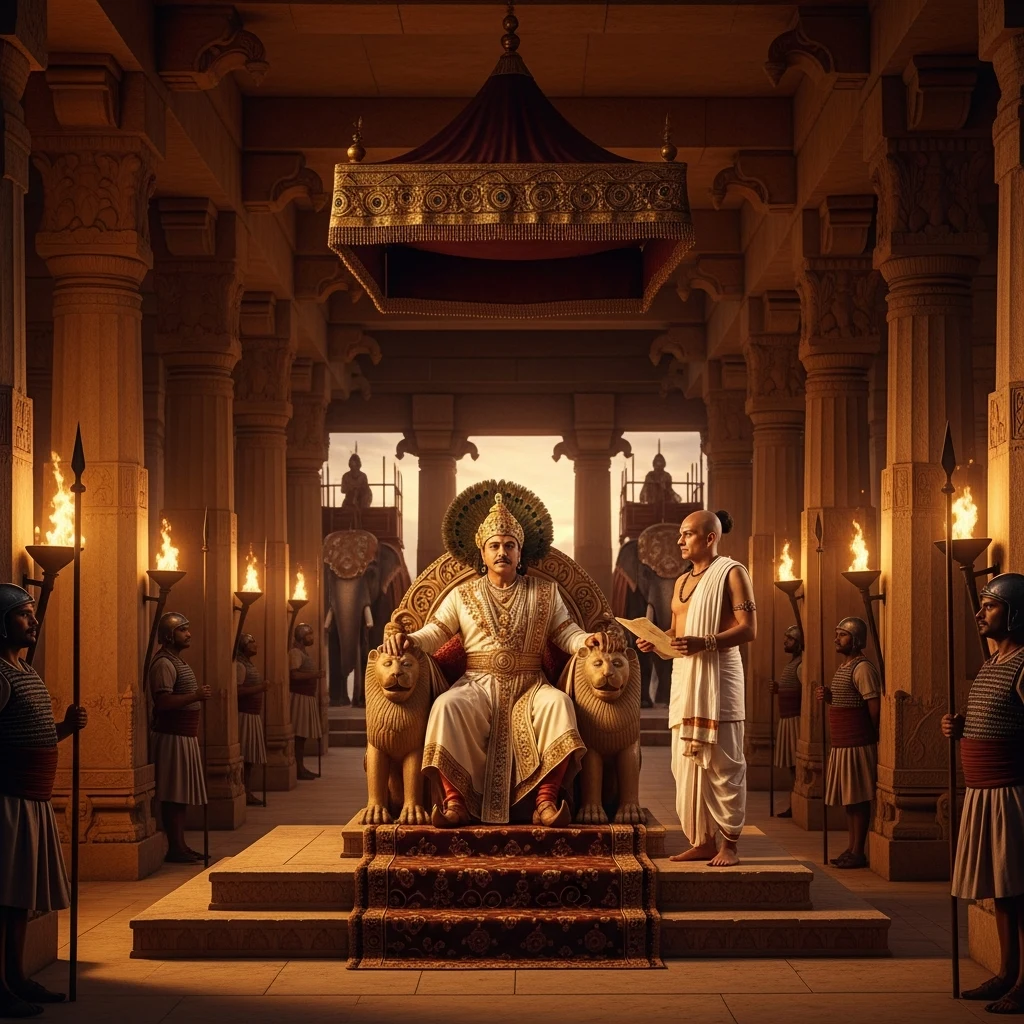
Chandragupta arrives. He bows to Chanakya. Then, at Chanakya's direction, he bows to Rakshasa. Not to a prisoner. To a peer.
The young king speaks to Rakshasa with what sounds, from outside, like a compliment: "What part of the world will not be conquered by me now that you, who are a very Brihaspati in politics, will vigilantly look after the affairs of state?"
Rakshasa recognizes the implicit offer — and his first instinct is to read it as a barb, as one more move in the game. Then he stops himself. He thinks it through. And he concludes, grudgingly, that his spite is distorting his reading. It is, in truth, a genuine compliment from a king who means it.
The recognition costs him something. It costs him the comfortable story in which Chandragupta is simply the inheritor of what Chanakya stole — a puppet on a throne, unworthy of a minister of Rakshasa's caliber. The young man in front of him is not that. He is, Rakshasa concedes to himself, exactly the kind of king who deserves an able minister.
## The Sword
Chanakya hands Rakshasa the sword. The minister's sword — the badge of office, the object that makes the acceptance formal and public and binding.
Rakshasa refuses. He says he is not fit to wield it — and least of all the sword that Chanakya himself has been carrying.
Chanakya says: how can that be? And he recites the damage Rakshasa's genius caused — the war elephants that went unmaintained because they were always mobilized, the horses kept perpetually bridled and saddled and wasting. The Maurya army was ground down for months, not by defeats but by the constant threat of a strategist who could strike anywhere. This is, in its way, a tribute. Chanakya is acknowledging that Rakshasa was his equal.
Then the lever: unless you take this sword, Chandanadasa dies.
There is a long silence in the text. Then Rakshasa speaks:
"Well, Vishnugupta — I bow submission. I yield to the affection for a friend that compels me to agree to anything and everything."
He takes the sword.
Chanakya turns to Chandragupta and congratulates him. The king says he is fully alive to the minister's kindness. And it is kindness — though not the soft kind. It is the kindness of a man who has spent months engineering a trap, not to destroy his enemy but to give him somewhere to land without dishonor.
## The Settlement
Rakshasa's first act as minister is to plead for Malayaketu's life. Chanakya grants it immediately. He has been waiting for Rakshasa to ask, and the speed of the grant is itself a signal: this is how things work now. The minister asks, the king hears, Chanakya advises, the decision is made. Malayaketu is not only spared but restored to the kingdom his father left him.
Chandanadasa — who refused to betray his friend, who walked to the execution stake without flinching — is made paramount headman of the guilds of all townships in the empire.
All bonds are removed. The war is over.
## The Theme
Vishakhadatta wrote this play in a period when the Arthashastra tradition — the cold science of statecraft that Kautilya represents — was well understood by educated audiences. The play does not pretend that Chanakya is good in the ordinary sense. He manipulates almost everyone who appears onstage. He has men followed, letters forged, coalitions destroyed from within.
He uses Chandanadasa's death sentence as a psychological lever, keeping an innocent man at the edge of execution for months because he knows exactly what it will produce. He is ruthless, patient, and completely without illusions about what statecraft requires.
But the play complicates the judgment. Chanakya's goal — the only goal he works toward through every act — is not territory or wealth or revenge. It is to win over one incorruptible man without destroying him. He could have had Rakshasa killed at any of a dozen points. He never tries.
The entire intricate campaign is designed to bring Rakshasa to the burning ground, stripped of everything except his loyalty — to see if, when the last chips are down, that loyalty will transfer to a worthy king.
It does. And when it does, Chanakya steps back. He has no victory speech. He removes his armor and bows.
The play's title is Mudrarakshasa — "Rakshasa through the Mudra," or "Rakshasa of the Signet Ring." The ring is the instrument of the entire plot: it is what Chanakya recovers, what Chanakya uses to forge the letter, what brings Rakshasa's coalition down, what drives the chain of events that leads to the burning ground.
But the ring is also, in the end, a symbol of something else. A signet ring is a mark of identity. The question the play asks is: whose mark does Rakshasa bear? Which king does his genius serve? The ring, taken from him by Chanakya, is the means by which Chanakya answers that question — and gives Rakshasa's identity back to him, resealed under a new name.
## An Open Door
The two greatest political minds of their era stand together at the end, on the same side of the same throne, and the empire is whole.
Chanakya does not retire. He does not leave. The coat of mail goes back on, the sword stays in the minister's hand, and the court resumes. But something has shifted. Chanakya has won the only victory he cared about — not the campaign of armies, but the campaign of a single man's conscience.
Rakshasa, for his part, has discovered that submission to a worthy king is not the same as defeat. His integrity is intact. His friend lives. His skill, which he spent months pouring into the cause of men already dead, is now pointed at a future that might actually be worth serving.
The signet ring is somewhere in that room. It has passed through too many hands to know exactly whose pocket it rests in. It no longer matters. The seal has been set on something larger than a letter.
The court stills. The play ends. And the empire — unified not by conquest but by the maneuvering of a ring and the loyalty of a friend — is left to govern itself.
The Minister, the Signet Ring, and the War of Wits
सङ्क्षिप्तकथा
Vishakhadatta’s seven-act political thriller in one sitting: Chanakya has crowned Chandragupta, but the Nandas' minister Rakshasa still plots in exile. With no battle to fight, Chanakya wins with a lost signet ring, a feigned quarrel, and a forged letter — until the loyal Rakshasa is snared by his own virtue.